
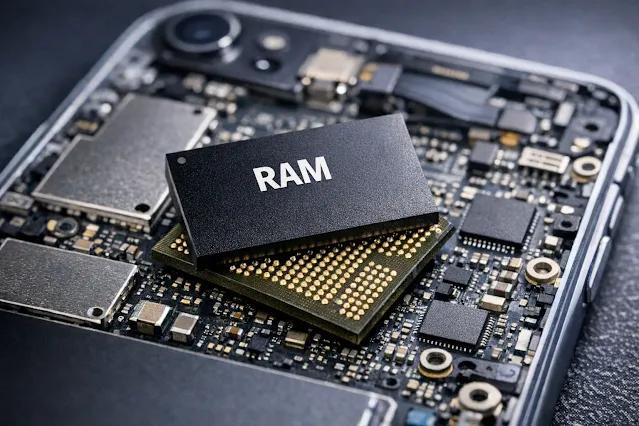
Random Access Memory (RAM) is one of the most important components in a smartphone. While the operating system (OS) acts as the brain of the device, it works as the workspace where apps and processes run. The amount directly affects how smooth, fast, and stable your smartphone feels in daily use.
Table of Contents
Low Power Double Data Rate 5x (LPDDR5x)
It is the definitive memory standard for high-performance gaming smartphones. In mobile gaming, it acts as the high-speed highway connecting the processor (CPU/GPU) to your game files. LPDDR5X dramatically changes the gaming experience through three core tech advancements.
What Does it Actually Do in a Smartphone?
It is your phone’s short-term memory. It temporarily stores active apps and background processes so that LPDDR5X: Why It Matters for Smartphone Gaming.
LPDDR5X (Low Power Double Data Rate 5X) has become a key memory standard in high-performance smartphones, particularly flagship and gaming-focused devices. In mobile gaming, it serves as a high-speed workspace that allows the CPU and GPU to access the data and assets required by demanding games quickly.
Compared with earlier LPDDR generations, LPDDR5X brings improvements in memory bandwidth, power efficiency, and overall responsiveness, which can contribute to smoother gaming and better sustained performance.
1. Higher Bandwidth for Smoother Gaming
Memory bandwidth is important when a smartphone needs to process large amounts of game data. LPDDR5X can reach data rates of up to 8.5 Gbps, providing significantly more bandwidth than earlier LPDDR5 implementations.
- The Impact: Asset-heavy open-world games such as Genshin Impact and Wuthering Waves continuously stream textures, character models, environments, and other data as you move through the game world.
- The Result: Higher memory bandwidth helps reduce potential data bottlenecks between the processor and memory, allowing the CPU and GPU to access data more efficiently. This can contribute to more consistent frame rates, particularly in demanding gaming scenarios.
However, LPDDR5X alone cannot eliminate frame drops or stuttering. GPU performance, thermal management, storage speed, game optimization, and the overall SoC also play major roles.
2. Better Power Efficiency for Longer Gaming Sessions
Gaming places a heavy load on a smartphone’s processor and GPU, making power efficiency especially important. LPDDR5X introduces improvements designed to reduce memory power consumption while maintaining high data-transfer rates.
- The Impact: Lower memory power consumption can help reduce overall energy usage and heat generation during demanding workloads. Excessive heat can eventually trigger thermal throttling, which reduces processor performance to keep temperatures under control.
- The Result: More efficient memory can contribute to better battery endurance and sustained performance during longer gaming sessions, although the overall thermal and power characteristics of the smartphone depend on its entire hardware design.
3. Faster Data Access and Improved Responsiveness
LPDDR5X also improves memory performance through higher data rates and refinements to its memory architecture. Faster memory access can help the processor handle the large volume of data generated by modern games more efficiently.
- The Impact: Modern games constantly move data between storage, memory, CPU, and GPU. High-resolution textures, character models, visual effects, and other game assets all require rapid data access.
- The Result: Faster memory can contribute to a more responsive gaming experience and help the system handle demanding workloads more efficiently.
However, it is not the only factor determining loading times. Storage technology, such as UFS, game optimization, CPU performance, and the way a game manages its assets can have a much greater impact on how quickly a game launches or loads a level.
The Bottom Line
LPDDR5X does not magically make a smartphone faster, but it provides the high bandwidth and power efficiency needed by modern mobile processors. When paired with a powerful SoC, fast storage, and an effective cooling system, LPDDR5X can help deliver smoother gameplay, better multitasking, and more consistent sustained performance.
For gamers, therefore, LPDDR5X is an important part of the overall performance equation—but it should not be considered a standalone guarantee of higher FPS or faster loading times.
Gaming Performance
Mobile gaming has grown massively over the past decade. Modern AAA titles now demand powerful processors, advanced graphics engines, and sufficient RAM to perform smoothly.
Popular games like PUBG/BGMI, Genshin Impact, and Wuthering Waves push smartphones to their limits. To handle high frame rates, detailed textures, and large maps, it plays a crucial supporting role.
Newer technologies such as LPDDR5X (with speeds up to 8.5Gbps) help games load faster, maintain stable FPS, and process real-time game data efficiently. With 8GB, most users can enjoy smooth gameplay, but heavier gamers may benefit from 12GB for better long-term stability.
Camera Performance
RAM also supports your smartphone’s camera performance. While it doesn’t improve megapixels, it significantly affects processing speed and overall responsiveness.
- Fast Image Processing: In HDR or Night Mode, the phone captures multiple frames simultaneously. These frames are temporarily stored in RAM before being merged into a final image.
- 4K / 8K Video Recording: High-resolution video requires large memory buffers. More RAM helps maintain stable frame rates and smoother stabilization.
- AI Processing: Features like scene detection, object tracking, background blur, and real-time filters rely on RAM during processing.
In short, sufficient RAM ensures faster camera opening, quicker photo processing, and smoother multitasking while recording videos.
Artificial Intelligence (AI) Performance
In 2026, 8GB of RAM remains sufficient for budget-conscious users and those with basic or casual needs. However, for on-device AI applications and more demanding workloads, more than 8GB of RAM is increasingly necessary.
For a smooth, performance-focused, and more future-ready experience, 12GB or 16GB of RAM has become the preferred standard, offering greater headroom for multitasking, AI features, gaming, and demanding applications.
RAM Comparison Table for Practical Usage
| Usage Type | 4–6GB | 8GB RAM | 12GB RAM |
|---|---|---|---|
| Casual Use | Smooth | Smooth | Smooth |
| Heavy Multitasking | Frequent Reloads | Occasional Reloads | Stable |
| AAA Gaming | Noticeable Lag | Good Performance | Excellent Stability |
| Future-Proofing | 1–2 Years | 2–3 Years | 4–5 Years |
Final Verdict
In 2026, 8GB RAM is still a solid choice for most smartphone users. It handles daily tasks, social media, multitasking, and even demanding games quite well.
However, if you are a heavy gamer, content creator, or someone who wants long-term future-proof performance, 12GB RAM offers better stability and longevity.
For the majority of users, though, 8GB RAM strikes the perfect balance between performance, efficiency, and value.
Updated: August 10, 2026