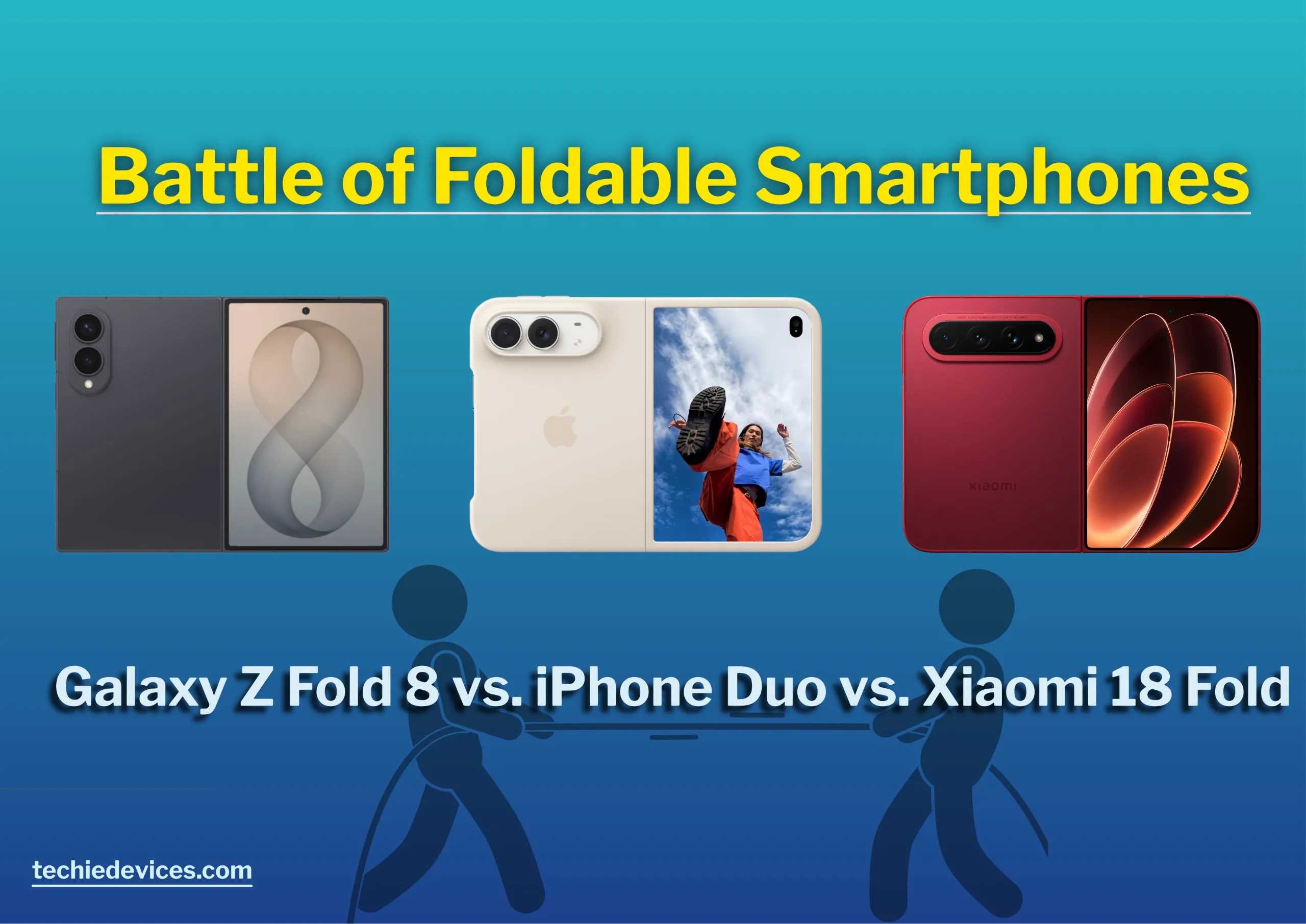
Z Fold 8 vs. iPhone Duo vs. 18 Fold: Which Flagship Foldable Should You Buy?
The battle for the ultimate foldable smartphone is heating up, with Samsung’s established Galaxy Z Fold 8, Apple’s ambitious iPhone Duo, and Xiaomi’s intriguing 18 Fold competing for your attention. Each packs cutting-edge OLED displays, flagship processors, and impressive efficiency, but raw specifications tell only part of the story.
At first glance, these foldables may seem remarkably similar. Look closer, however, and you’ll discover that each brings a distinct personality, unique strengths, and its own set of compromises. In this breakdown, we’ll explore what sets them apart and help you decide which foldable deserves a place in your pocket.
Table of Contents
Display: Which Foldable Has the Better Display?
The display is arguably the most important part of any foldable smartphone, and all three contenders promise an impressive viewing experience. The Samsung Galaxy Z Fold 8 and iPhone Duo feature similarly sized 7.6-inch inner displays, while Xiaomi’s 18 Fold comes in slightly smaller at 7.58 inches. A difference that is practically negligible in everyday use.
However, screen size alone doesn’t determine display quality. Brightness, resolution, color accuracy, refresh rate, and HDR support all contribute to the overall viewing experience.
Display Technology: Marketing Names vs. Actual Differences
Although these manufacturers use different names for their display technologies, the underlying hardware shares several similarities.
- LTPO Super Retina XDR OLED: Apple’s branding for its premium OLED displays, combining LTPO technology with Apple’s display tuning, color calibration, and HDR implementation. iPhone Duo is more versatile because it supports an Apple Pencil.
- Dynamic LTPO AMOLED 2X: Samsung’s branding for its advanced AMOLED panels, featuring adaptive refresh rates, high brightness, and optimized power efficiency.
- LTPO AMOLED: Xiaomi’s broader display technology designation, combining OLED image quality with an adaptive refresh rate to balance smoothness and power consumption.
Ultimately, the differences in display quality come down to the underlying panel specifications, manufacturer tuning, and real-world performance rather than the marketing names alone.
Display Specifications Compared
| Specification | Galaxy Z Fold 8 | iPhone Duo | Xiaomi 18 Fold |
|---|---|---|---|
| Inner Display | 7.6-inch Dynamic LTPO AMOLED 2X | 7.6-inch LTPO Super Retina XDR OLED | 7.58-inch LTPO AMOLED |
| Resolution | 2448 × 1848 pixels (~404 ppi) | 1878 x 2670 pixels (~430 ppi) | 2364 × 1672 pixels (~382 ppi) |
| Peak Brightness | 3,000 nits | 3,000 nits | 4,000 nits |
| Cover Display | 5.5-inch Dynamic LTPO AMOLED 2X | 5.4-inch LTPO Super Retina XDR | 5.38-inch Dynamic LTPO AMOLED |
| Refresh Rate | 1–120Hz | 1–120Hz | 1–120Hz |
| HDR Support | HDR10+ and Dolby Vision | Dolby Vision and HDR10 | Dolby Vision and HDR Vivid |
| Additional Features | Anti-reflective coating | nano-texture top finish | No reflective coating |
| Stylus Support | No | Apple Pencil (USB-C) | No |
Which Display is Better?
- Apple iPhone Duo leads in Apple Pencil support, good for taking notes, making it an exceptional canvas for precise note-taking, sketching, and document markup. The nano-texture top finish is a game-changer; it scatters ambient light to make the display nearly matte.
- Xiaomi’s 18 Fold leads in peak brightness, with its claimed 4,000-nit output surpassing Samsung and Apple’s 3,000-nit ratings. This could give Xiaomi an advantage when viewing content outdoors or in particularly bright environments.
- Samsung, meanwhile, offers similarly sized inner displays with competitive brightness specifications. Their actual viewing experiences will depend heavily on color calibration, HDR implementation, and how effectively each manufacturer manages reflections.
Performance: Which Foldable Has the Better Processor?
The processor is the core that determines whether a phone can smoothly handle massive triple-app multitasking or crumble under the pressure of next-gen workloads. The Galaxy Z Fold 8 is backed by an optimized Snapdragon 8 Elite Gen 5 (3nm), while Apple is powered by A20 Pro (2nm) and Xiaomi’s powerful XRing 03 platform.
RAM and Storage
All three premium foldables offer 12GB of RAM and a base storage configuration of 256GB. However, their storage technologies and maximum capacities differ.
| Specification | Galaxy Z Fold 8 | iPhone Duo | Xiaomi 18 Fold |
|---|---|---|---|
| Processor | Snapdragon 8 Elite Gen 5 | Apple A20 Pro | Xiaomi XRing 03 |
| RAM | 12GB | 12GB | 12GB |
| Base Storage | 256GB UFS 4.0 | 256GB | 256GB UFS 4.1 |
| Maximum Storage | 1TB | 2TB | 1TB |
Apple takes the lead in maximum storage capacity, offering up to 2TB, while Samsung and Xiaomi top out at 1TB. Xiaomi also features the newer UFS 4.1 storage standard, which offers improvements over UFS 4.0 in certain areas of performance and efficiency.
Benchmark Performance: Who Takes the Lead?
The 8 Elite Gen 5 is last year’s top performer by Qualcomm, and the phone was released early this year and can hit scores of more than 2.9 million on AnTuTu v11. However, the latest processor by Apple scores nearly 3.5 million, and Xring hit a massive score of over 5.2 million.
Benchmark figures are based on the reported results provided for this comparison. Actual scores may vary depending on device configuration, software version, temperature, and testing conditions.
But getting top scores does not guarantee top performance; Samsung is well optimized among the bunch, followed by Xiaomi. Obvious point: Samsung is a veteran in making folding smartphones; multitasking feels mature. When it comes to multitasking, Xiaomi Fold can open multiple apps, while Duo is the only smartphone that is limited to only 3 applications.
Design & Build: Weight, Thickness, and Durability
A premium foldable must not only perform well but also feel exceptional in the hand of the user. This generation highlights a fierce engineering battle, with each manufacturer prioritizing a completely different aspect of hardware.
Design and Portability Compared
| Design Metric | Samsung Galaxy Z Fold 8 | Apple iPhone Duo | Xiaomi 18 Fold |
|---|---|---|---|
| Weight | 201g (Winner) | 254g | 219g |
| Folded Thickness | 9.7mm | 10.9mm | 9.2mm |
| Frame Material | Armor Aluminum | Grade 5 Titanium | Carbon Fiber Composite |
| Ingress Protection | IP48 Dust & Water | IP68 Dust & Water | IPX8 Water Only |
The Trade-Off Between Weight and Durability
- Samsung’s Physics Victory: The Galaxy Z Fold 8 completely redefines foldable portability by weighing an astonishing 201g. Samsung achieved this by completely redesigning its hinge assembly with lighter alloys, making it lighter than many traditional slab smartphones.
- Xiaomi’s Ultra-Thin Engineering: If thickness matters most to you, the Xiaomi 18 Fold takes the crown at a razor-thin 9.2mm when closed. It uses a lightweight carbon fiber composite frame that prevents it from feeling bulky in a pocket.
- Apple’s Heavy Armor: The iPhone Duo is noticeably heavier at 254g. However, Apple uses that extra mass to deliver a premium Grade 5 Titanium frame and an industry-leading IP68 rating, offering the best dust and water protection of the trio.
Reliability & The Realities of First-Gen Hardware
Samsung is a veteran in the foldable smartphone market, and years of experience have helped it refine its hinge mechanisms, display technology, and overall durability. Apple, on the other hand, is still in the early stages of its foldable journey, and the iPhone Duo’s reported inner-display issues have raised questions about its first-generation design. For a deeper look, check out our iPhone Duo: How Apple’s $2,000 Foldable Turned Into a Nightmare.
Xiaomi, meanwhile, appears to have learned valuable lessons from the early challenges faced by Samsung’s foldables, incorporating those insights into its own design. While no widespread hardware failures have been reported so far, its long-term reliability will ultimately depend on how well the device holds up under everyday use.
Camera Capabilities
Usually, foldable smartphones compromise on camera hardware to deliver a thin premium profile. But Xiaomi has completely broken that tradition by packing triple cameras into its thin chassis; Apple and Samsung take a more streamlined and software-reliant approach.
Camera Hardware Comparison
| Camera Element | Samsung Galaxy Z Fold 8 | Apple iPhone Duo | Xiaomi 18 Fold |
|---|---|---|---|
| Main Sensor | 50MP (f/1.8, OIS) | 48MP (f/1.78, OIS) | 200MP Leica Vario |
| Telephoto Lens | 12MP Digital Crop | 12MP Digital Crop | 50MP Periscope |
| Optical Zoom Range | N/A (In-sensor crop) | N/A (In-sensor crop) | 3.5x True Optical Zoom |
| Ultra-Wide Lens | 12MP (123° FoV) | 12MP (120° FoV) | 50MP (118° FoV) |
Real-World Camera Performance
Xiaomi’s partnership with Leica brings a camera setup to the 18 Fold comprising a 200MP primary sensor, a 50MP periscope telephoto lens, and a 50MP ultra-wide camera. The combination offers flexibility for everyday photography, covering everything from standard shots to zoom and wide-angle images.
Apple & Samsung’s Zoom Compromise: Both the Galaxy Z Fold 8 and iPhone Duo omit a dedicated optical telephoto lens entirely in their base configurations. Instead, they rely on digital sensor cropping from their 50MP and 48MP main cameras to simulate zoom.
Battery Life & Charging
| Battery Metric | Samsung Galaxy Z Fold 8 | Apple iPhone Duo | Xiaomi 18 Fold |
|---|---|---|---|
| Battery Capacity | 4,400 mAh | 4,650 mAh | 6,000 mAh |
| Battery Tech | Dual-Cell Li-Po | Dual-Cell Li-Ion | Silicon-Carbon Anode |
| Wired Charging Speed | 25W | 30W | 67W |
| Wireless Charging | 15W MagSafe-compatible | 25W MagSafe | 50W Wireless |
Xiaomi 18 Fold utilizes a silicon-carbon anode battery pack with 6,000mAh capacity, with 67W wired fast charging and 50W wireless charging; it lasts the longest and charges fast.
Apple and Samsung continue to use dual-cell lithium architectures split across both halves of the folding chassis. The iPhone Duo (4,650 mAh) manages slightly better efficiency due to the 2nm A20 Pro chip, while the Galaxy Z Fold 8 (4,400 mAh) relies heavily on Samsung’s aggressive software battery saving to push through a full workday.
The Final Verdict & Price
- Buy the Samsung Galaxy Z Fold 8 if: You want a highly reliable, mature multitasking machine that feels like a standard phone in your pocket. At just 201g, it eliminates the historical bulkiness of foldables while offering the mature and well-established software experience on the market. Starting at $1,699.99/₹1,74,999
- Buy the Apple iPhone Duo if: You are heavily invested in the iOS ecosystem and want unmatched processing longevity via the 2nm A20 Pro chip. It is the best choice if you plan to use an Apple Pencil for daily note-taking and value rugged IP68 dust and water protection, provided you are willing to risk first-generation hardware kinks. Starting at $2,000/₹2,99,900
- Buy the Xiaomi 18 Fold if: You are a tech enthusiast seeking raw hardware dominance (4,000 nits, 200MP Leica camera) and are willing to jump through importing hoops. Keep in mind that it remains a China-exclusive release starting at CNY 10,999 (~$1,639 /~₹1,55,000), and international shipping, customs duties, and third-party markup can easily double the final price depending on your global region.
Frequently Asked Questions (FAQs)
Is LTPO Super Retina XDR Better than LTPO AMOLED?
An LTPO Super Retina XDR OLED is fundamentally an LTPO AMOLED panel; as Apple calls it, “Super Retina XDR” is built using an LTPO backplane that supports adaptive refresh rates from 1 Hz to 120 Hz via ProMotion.