Best Smartphone Processor for 2027: Geekbench & AnTuTu Leaderboard
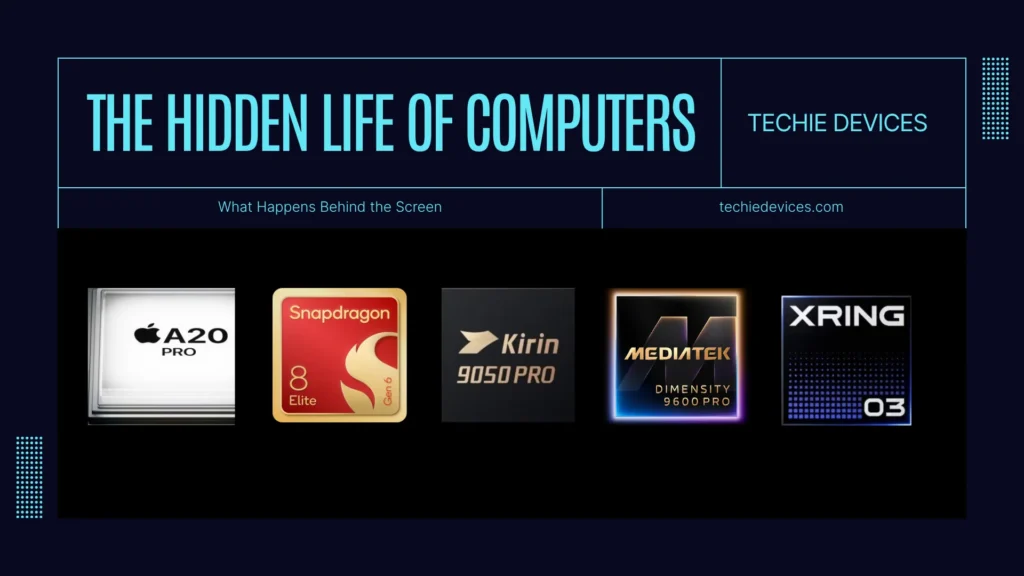
Qualcomm, MediaTek, Apple, and Xiaomi have officially launched their next-generation smartphone processors, signaling the dawn of a new era in mobile technology. These top silicon architectures take wildly different paths to achieve peak performance.
While most brands have shifted toward the cutting-edge 2-nanometer process node to maximize power and efficiency, Xiaomi has taken a unique approach. Built on a refined 3-nanometer node, its Xring 03 relies on a massive Deca-core (10-core) layout to maximize raw processing power.
Whether you are a casual user looking for a seamless upgrade, a content creator demanding video rendering, or a spec enthusiast tracking raw clock speeds, these chips change the game. In this breakdown, we will dive into what these premium architectures bring to the table, how they evolve past their predecessors, and exactly how they stack up on the Geekbench and AnTuTu leaderboards.
Table of Contents
Qualcomm Snapdragon 8 Elite Extreme Gen 6 and 8 Elite Gen 6
The Qualcomm 8 Gen Elite 6 and Elite Extreme were launched in September 2026 as next-gen 2-nanometer mobile SoCs. These are the only System-on-Chip (SoC) Octa-core processors with two prime cores that reach up to 5Ghz in this breakdown, six performance cores that reach up to 4Ghz, 16MB cache, 64-bit, and both chips are built on 2-nanometer nodes.
Qualcomm stated that the 8 Elite Extreme Gen 6 improved by 13% in CPU, 44% in GPU, and 35% in NPU, whereas the 8 Elite Gen 6 improved by 10% in CPU, 35% in GPU, and 14% in NPU performance. In terms of performance, these are capable of hitting raw performance scores as well as taking a step toward agentic AI.
A strong smartphone processor is not only about raw power but also about efficiency and improvement. The 8 Elite Extreme Gen 6 is 37% more efficient in CPU, 40% in GPU, and 35% in NPU performance-per-watt, and the 8 Elite Gen 6 is improved by 37%, 40%, and 20%, respectively.
Key Specs & Upgrades:
- Advanced Agentic AI: Next-gen on-device AI processing capabilities.
- AnTuTu Scores: The Extreme Gen 6 scores over 5.1 million points, while the Elite Gen 6 reaches 4.9 million (as listed on NanoReview).
- Geekbench 6 Scores: The Extreme Gen 6 hits 4,327 (single-core) and 12,873 (multi-core). The Elite Gen 6 scores 4,301 (single-core) and 12,490 (multi-core).
- Display Support: Supports up to 4K at 120Hz or QHD+ at 240Hz on-device, alongside external display support up to 4K at 120Hz or 8K at 30Hz.
- 5G Modem Speeds: Blistering peak downloads up to 14.8 Gbps and uploads up to 4.2 Gbps on both SoCs.
- Camera Capabilities: Image signal processing supporting up to a massive 320MP photo capture.
- Video & Media: The Extreme Gen 6 supports 10-bit HEIF/HEIC capture, APV video formats, 8K recording up to 60fps, and 4K up to 240fps. The standard Elite Gen 6 is limited to HEIC photos, 8K recording at 30fps, and 4K at 120fps.
- Storage & Ports: Next-generation UFS 4.0/5.0 support and USB Type-C (USB 3.1 Gen 2)
Apple A20 Pro
This smartphone processor, the Apple A20 Pro, was unveiled in September 2026as the heart of these flagship iPhones: iPhone 18 Pro, 18 Pro Max, and iPhone Duo. The architecture utilizes a 6-core setup, featuring two “super” cores that clock up to 4.93 GHz paired with four high-efficiency cores. Apple states that this new layout drives a 20% leap in CPU performance. Graphics get a bigger boost: a newly designed 7-core GPU delivers up to a 40% increase in graphics performance alongside hardware-accelerated ray tracing
For AI workloads, this smartphone processor implements a Dual 16-core Neural Engine means total of 32 cores that double the AI processing capability. It is 35% faster in terms of CPU, 40% faster in graphics, and twice the AI processing of the A19 Pro, and is also built on a 2-nanometer node.
Key Specs & Upgrades:
- Dual-Core NPU: Next-generation 32-core Neural Engine designed for intense Apple Intelligence tasks.
- AnTuTu 11 Scores: The chip shatters previous limits, pushing an overall score of approximately 3.43 million points.
- Geekbench 6.7.0 Scores: Destroys mobile standards with a single-core score of 4,772 and a multi-core matrix hitting 12,989
- Thermal Management: Side-by-side die placement engineered against a custom vapor chamber ensures the phone stays cool during prolonged workloads.
- Creator-Centric Media: A dedicated display engine capable of driving dual displays simultaneously, paired with up to ProRes UHD 120 FPS video capture/playback and rapid 4K timeline rendering.
- Connectivity: Integrates Apple’s new in-house C2 5G modem alongside the N1 wireless chip for native Wi-Fi 7 and Bluetooth 6.0
MediaTek Dimensity 9600 Pro
Another flagship smartphone processor known for its raw power, launched in September 2026, built on TSMC’s 2-nanometer process node. This SoC is based on an octa-core (8-core), two Arm C2-Ultra prime cores clocking up to 4.55 GHz, three performance cores at 4.35 GHz, and three auxiliary performance cores running at 3.1 GHz.
With this, it ditched small efficiency cores. However, the 2nm node brings a 61% reduction in multi-core power consumption, with a 17% increase in single-core CPU performance and 15% faster multi-core performance. It is also 51% faster because of its NPU 1090
Key Specs & Upgrades:
- Next-Gen Memory & Storage: The industry’s first platform supporting blazing-fast LPDDR6 RAM and next-gen UFS 5.0 storage.
- AnTuTu 11 Scores: The All-Big-Core layout achieves a towering benchmark score of approximately 4.83 million points.
- Geekbench 6 Scores: Pushes massive performance thresholds with a single-core score of 4,188 and a multi-core matrix hitting 13,145.
- Native AI Architecture: The NPU 1090 accelerates large language model prompt pre-filling by 51% while dropping always-on background AI tasks by 40%.
- Imagiq 1290 ISP: Connects camera sensors directly to the NPU for real-time computational photography, handling up to 200MP single camera captures and smooth 8K video recording at 60fps.
- Display & Layout Flexibility: Drives crisp WQHD+ displays up to 180Hz and natively includes hardware support for next-gen Tri-Fold smartphone architectures
Xiaomi Xring 03
Xiaomi’s Xring03 is a fascinating smartphone processor that runs on a 3-nanometer processor node architecture, giving tough competition to other processors with its Deca-core (10-core) configuration.
Rather than utilizing a traditional performance-and-efficiency cluster, Xiaomi counters with strong performance with a quad-cluster array featuring two C1-Ultra prime cores clocked at 4.35Ghz, four C1-Premium cores running at 3.68 GHz, and four C1-Pro cores hitting 3.15 GHz.
For graphics rendering and video exports, it pairs with a 16-core Mali-G2 Ultra NX GPU, which is 85% better in peak graphical performance and has a 64% reduction in overall power consumption compared to the previous generation.
Key Specs & Upgrades:
- First-to-Market Memory Support: Natively integrates an advanced 96-bit memory controller engineered to support rapid, next-generation LPDDR66 memory speeds up to 10,667 Mbps.
- AnTuTu 11 Scores: This deca-core processor crosses 5.2 million scores with ease.
- GeekBench 6 Scores: This smartphone processor achieves 3,715 scores in single-core and 14,213 scores in multi-core; these scores make Xring 03 a top-tier processor.
- Integrated Security Core: Built with a fully dedicated RISC-V security core to ensure zero-compromise encryption layers for local agentic data maps
- AI Architecture: The dedicated NPU hits up to 200 INT8 TOPS with its 8MB cache, which allows 30-billion-parameter model deployment natively.
Huawei Kirin 9050 Pro
Huawei bypassed traditional physical mode shrinkage entirely. Instead, they introduced the industry’s first commercial “LogicalFolding” 3D-stacking architecture, stacking logic vertically within a monolithic die to drive a massive 55% increase in transistor density.
Kirin 9050 is based on a 9-core configuration with hyper-threading, with 1 Prime core at 3.1 GHz, two performance cores, four efficiency cores, and 2 low-power cores, resulting in an increase of 24% in single-core performance and a 52% boost in multi-core performance compared to Kirin 9030 Pro
Graphics are anchored by a newly designed Maleoon GPU (such as the Maleoon 955), utilizing hardware-accelerated compute units to manage 50 MRPS real-time ray tracing and an astonishing 142% upgrade in rendering performance
The Vinci Architecture NPU introduces the first mobile deployment of an on-device Mixture of Experts (MoE) Large Language Model.
Key Specs & Upgrades:
- LogicFolding Integration: Vertical 3D silicon stacking achieves an impressive density of 238 million transistors per square millimeter.
- AnTuTu 11 Scores: The architectural density scaling registers an overall score of approximately 2.45 million points.
- Geekbench 7 Scores: Steps onto the Geekbench stage with an official single-core score of 1,117 and a multi-core score of 5,076.
- Next-Gen Communication: An upgraded Balong modem integrates ground 5G optimization with a 42% surge in satellite paging success rates via Tiantong and BeiDou satellite arrays.
- Advanced Content Creation: Deep hardware-software pipeline integration accelerates asset loading by 50%, while supporting 4K multitrack video editing timelines effortlessly
- Quantum-Grade Security: Delivers dual-chip-level security certified by Post-Quantum Cryptography (PQC) and EAL5+ CCRP standard protocols.
Final Geekbench & AnTuTu Leaderboard Table
| Processor Model | Node Process | CPU Layout & Features | Single-Core Score | Multi-Core Score | AnTuTu 11 Overall |
|---|---|---|---|---|---|
| Xiaomi Xring 03 | 3nm | 10-Core (Deca-core) | 3,715 (GB6) | 14,213 (GB6) | 5.20+ Million |
| Qualcomm Snapdragon 8 Elite Extreme | 2nm | 8-Core (5.0 GHz Prime) | 4,327 (GB6) | 12,873 (GB6) | 5.10+ Million |
| Qualcomm Snapdragon 8 Elite Gen 6 | 2nm | 8-Core (Octa-core) | 4,301 (GB6) | 12,490 (GB6) | 4.90 Million |
| MediaTek Dimensity 9600 Pro | 2nm | 8-Core (All-Big-Core) | 4,188 (GB6) | 13,145 (GB6) | 4.83 Million |
| Apple A20 Pro | 2nm | 6-Core (Hexa-core) | 4,772 (GB6) | 12,989 (GB6) | 3.43 Million |
The Final Verdict: Which Best Smartphone Processor?
Choosing the best smartphone processor in 2027 comes down to what your specific workflow demands:
- The Brute-Force Performance King: Xiaomi Xring 03
Thanks to its aggressive 10-core quad-cluster layout and massive 16-core Mali-G2 Ultra NX GPU, the Xring 03 dominates multi-core processing and claims the top spot on the AnTuTu leaderboard with over 5.2 million points. It is built for absolute power users. - The Single-Thread & Efficiency Champion: Apple A20 Pro
Apple continues its single-core dominance. Pushing a 4,772 score on Geekbench, its custom 6-core setup paired with a massive 32-core Neural Engine provides the fastest real-time responsiveness and unmatched optimizations for creator-focused apps, like rapid 4K timeline rendering. - The Balanced Flagship Powerhouse: Qualcomm Snapdragon 8 Elite Extreme
Qualcomm delivers the ultimate package for consumer premium flagships. With dual prime cores pushing all the way to a historic 5.0 GHz, blistering 14.8 Gbps 5G download capacities, and advanced dedicated agentic AI processing, it represents the gold standard for mainstream luxury phones. - The Communication & Security Pioneer: Huawei Kirin 9050 Pro
While it targets a separate performance tier in synthetic benchmarks due to manufacturing constraints, the Kirin 9050 Pro wins easily on pure innovation. By utilizing hyper-threading and a Mixture of Experts (MoE) local NPU design, it delivers game-changing Post-Quantum Cryptography and satellite connectivity options that leave other silicon architectures behind
Related Readings
- The Rise of Mobile Processors: From Single-Core to AI
- Qualcomm Snapdragon Elite 5 vs Gen 5 vs 8 Elite: Which Chip Actually Wins?
Frequently Asked Questions (FAQ):
Which smartphone processor has the best graphics performance in 2027?
The Xiaomi Xring 03 leads in raw compute power with its 16-core Mali-G2 Ultra NX GPU.
What makes the Qualcomm Snapdragon 8 Elite Extreme different from the standard version?
The Extreme variant pushes clock boundaries further, featuring two prime cores that hit a historic 5.0 GHz limit (compared to lower thresholds on standard platforms).
Which processor has the best single-core score?
Apple 20 Pro leads the Geekbench 6 chart with its massive 4,772 single-core score.
Which smartphone processor has the highest AnTuTu score?
Among the processors included in this comparison, the Xiaomi XRing 03 has the highest reported AnTuTu 11 score in the data used for this article.
Does a higher AnTuTu score mean better gaming performance?
Not necessarily. AnTuTu provides an overall performance score, but gaming performance depends heavily on GPU capability, sustained performance, thermal management, game optimization, and power consumption.
Which smartphone processor handles games like Wuthering Wave and Genshin better?
The A20 Pro delivers a consistent 60 fps in both games; Xring 03 achieves a solid 60 FPS at maximum settings. However, because the chip draws up to 18W at peak, it heats up considerably, and the 8 Elite Extreme Gen 6 and 8 Elite Gen 6 deliver a smooth 60 FPS initially but run the hottest under load, causing them to aggressively throttle performance