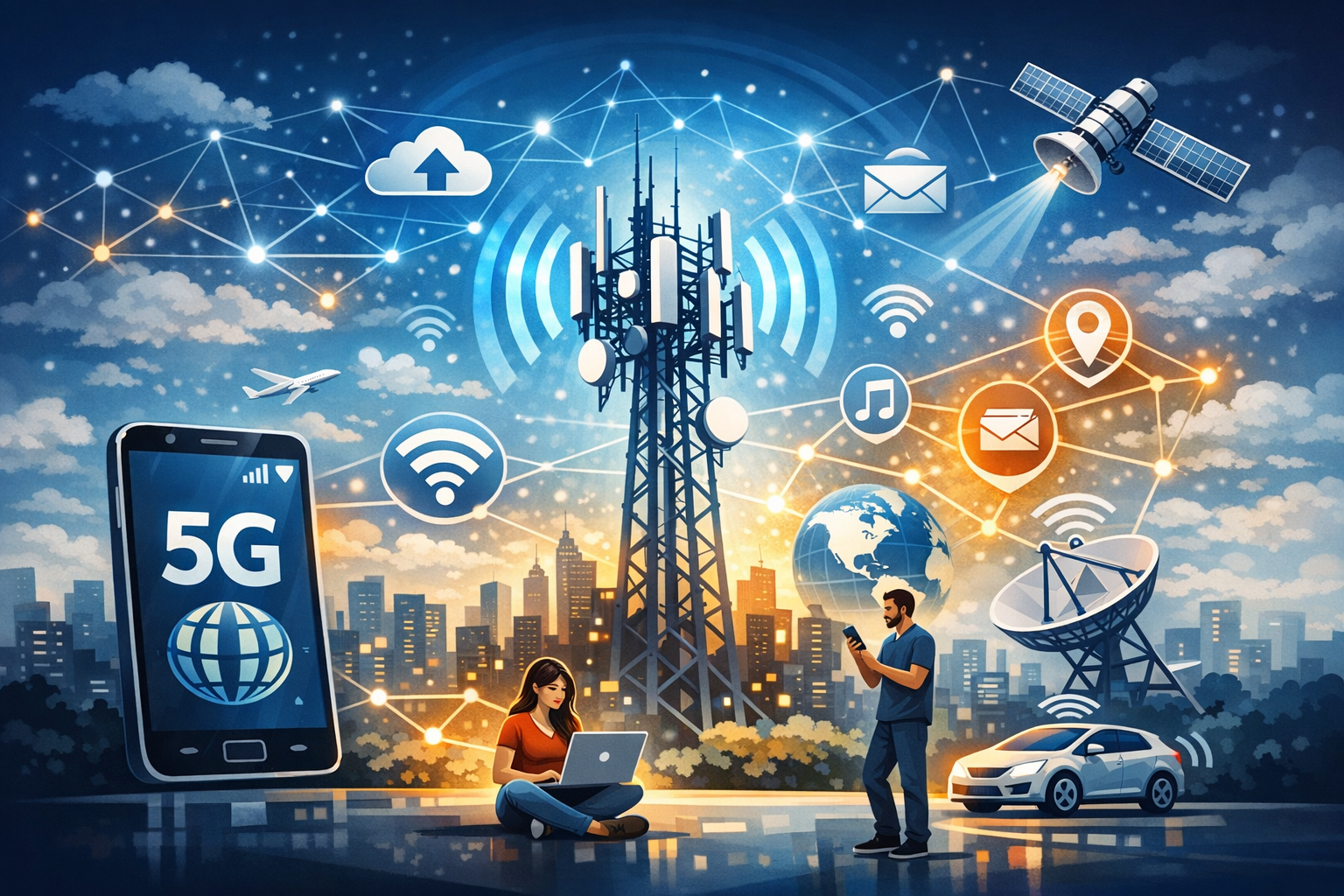
Over the last 50 years, the world has witnessed a revolutionary transformation in mobile communication networks. From basic analogue voice calls to ultra-fast internet speeds, mobile networks have continuously evolved to meet growing digital demands. Today, we are already experiencing the power of 5G, and experts predict that 6G technology may soon deliver speeds up to 100 Gbps with advanced AI-driven network optimisation.
In today’s digital era, almost everyone relies on smartphones, tablets, and other smart devices for communication, entertainment, business, and education. Wireless communication technology enables these devices to connect seamlessly for voice calls, text messaging, and internet services. Mobile networks operate using radio waves and interconnected base stations that transmit signals across cities, countries, and even continents.
What is a Mobile Network and How Does It Work?
A mobile network is a complex system made up of multiple interconnected components that work together to deliver seamless connectivity. Let’s break down the working process into simple steps:
1. Smartphone Device Communication
When you make a call or use mobile data, your smartphone sends signals in the form of radio waves to the nearest cellular tower.
This tower is known as a Base Transceiver Station (BTS). It acts as the first contact point between your device and the network.
2. Base Station Processing
The BTS forwards the signal to a Base Station Controller (BSC).
The BSC manages multiple towers and ensures efficient use of network resources such as bandwidth and frequency allocation.
3. Core Network Routing
The core network functions as the central processing system of mobile communication.
The BSC sends signals to the Mobile Switching Centre (MSC), which connects calls and messages to other networks.
If you call another mobile user, the MSC routes the call to their nearest cellular tower.
For internet usage, data is routed through the Packet Core Network, which connects your device to external networks such as the global internet.
4. Network Handovers
When you move from one location to another while on a call or using mobile data, the network automatically transfers your connection to the nearest tower.
This process, called handover, ensures uninterrupted service.
Mobile networks rely on fiber optics, microwave links, and sometimes satellite communication to connect different components and maintain high-speed data transfer.
Evolution and Types of Mobile Networks (1G to 5G)
Mobile networks have evolved through several generations, each bringing improved speed, security, and capacity. Below is a detailed overview of each generation:
1G – First Generation (1980s)
Introduced in the 1980s, 1G was the first generation of mobile networks.
It supported only analogue voice calls.
It had poor voice quality, limited coverage, no data services, and major security vulnerabilities.
2G – GSM and CDMA (1990s)
Launched in the early 1990s, 2G introduced digital communication.
GSM (Global System for Mobile Communication) became widely adopted.
It enabled SMS messaging, improved call clarity, and provided better encryption.
Maximum data speed was around 50 Kbps.
3G – CDMA, HSPA, HSPA+ (2000s)
Introduced around 2000, 3G significantly improved mobile internet capabilities.
It enabled video calls, web browsing, multimedia streaming, and mobile apps.
Data speeds reached up to 2 Mbps.
Later upgrades like 3.5G (HSPA+) increased speeds up to 42 Mbps.
4G – LTE and VoLTE (2010s)
Introduced around 2010, 4G brought high-speed broadband internet to smartphones.
LTE (Long Term Evolution) enabled HD video streaming, online gaming, and fast downloads.
VoLTE improved voice call clarity over LTE networks.
Speeds ranged from 100 Mbps to 1 Gbps under ideal conditions.
5G – Massive MIMO and mmWave (2020s)
Launched globally around 2020, 5G represents the latest generation of mobile connectivity.
It uses technologies such as mmWave spectrum and Massive MIMO (Multiple Input Multiple Output).
5G can achieve speeds up to 10 Gbps.
It offers ultra-low latency of 1–20 milliseconds.
Supports advanced applications like IoT, smart cities, autonomous vehicles, and cloud gaming.
The Future: 6G and Beyond
While 5G is still expanding globally, researchers are already developing 6G technology. Expected to launch by 2030, 6G may offer speeds up to 100 Gbps with AI-powered network optimisation. It could enable holographic communication, real-time digital twins, and advanced augmented reality experiences.
Conclusion
From 1G’s basic analog calls to 5G’s ultra-fast smart connectivity, mobile networks have revolutionized the way we communicate and access information. Each generation has introduced major improvements in speed, security, and reliability. As we move toward 6G, the future of wireless communication promises even faster speeds, intelligent automation, and seamless global connectivity.